In preventive testing of power systems, transformer insulation resistance testing is the most fundamental and commonly used method to determine the main insulation condition of equipment. But an easily overlooked reality is that the reliability of test results often does not depend on the technical level of the operators, but is determined by the selection of testing equipment from the beginning. Choosing the wrong equipment makes it difficult to obtain valuable data even with standardized on-site operations.
Voltage level matching is the first principle of selection
The output voltage of the insulation resistance tester must strictly match the rated voltage level of the tested transformer, which is the most essential rule in selection. Insufficient output test voltage results in weak leakage current response of insulation defects under low voltage, making it difficult to reflect deep insulation degradation; If the voltage is too high, it may cause unnecessary stress on the insulation structure.
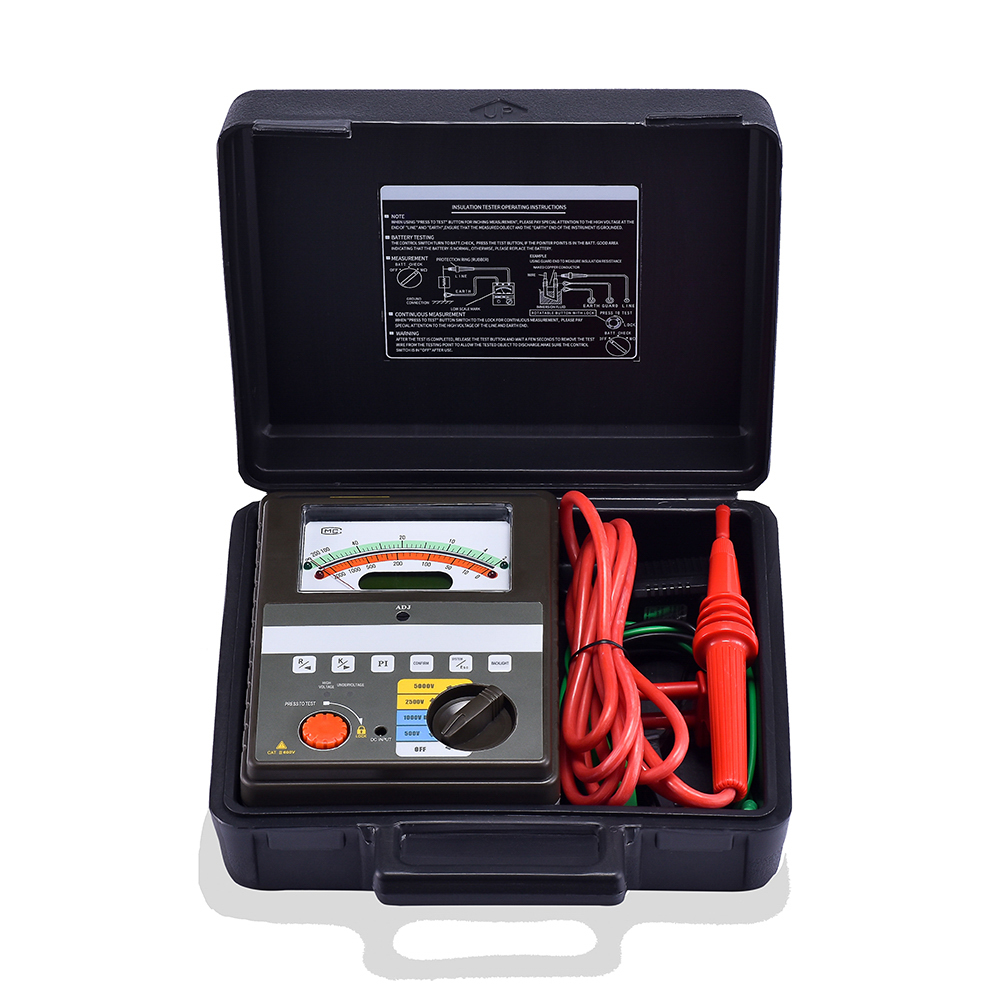
The BC2010 intelligent dual display insulation resistance tester from Wuhan UHV Power Technology Co., Ltd. provides four output voltage options: 500V, 1000V, 2500V, and 5000V. The measurement range covers 0 to 1T Ω and the range automatically switches to meet the testing needs from distribution transformers to high-voltage main transformers. For large transformers with a voltage of 110kV and above, a tester with an output capacity of 5000V or higher should be selected. If the voltage is too low, the measurement results may not reflect the true insulation state.
Range and accuracy determine the reliability of data
Choosing the right voltage level can also cause problems if the range and accuracy cannot keep up. Insufficient measurement range can lead to overflow of test data for high insulation level equipment, and insufficient accuracy may result in misjudging critical abnormal insulation values as qualified. According to industry statistics, missed or false detections caused by improper selection of insulation testing equipment account for 27.6% of the causes of insulation failures and are one of the important reasons for unplanned power outages.
The functions of absorption ratio and polarization index cannot be omitted
The absolute value of transformer insulation resistance is greatly affected by environmental factors such as temperature and humidity, and it is difficult to make reliable judgments based solely on one insulation resistance reading. The regulations require that absorption ratio and polarization index tests be conducted simultaneously during insulation resistance testing. An absorption ratio lower than 1.3 usually indicates insulation moisture or the presence of continuity defects, while a significantly lower polarization index often indicates a more severe degree of aging of the insulation material.
This means that the tester must not only be able to measure resistance values, but also have the ability to automatically collect data for 15 seconds, 60 seconds, and 10 minutes at regular intervals and automatically calculate absorption ratio and polarization index. The method of manually pinching the meter reading is almost impractical in the 10 minute polarization index test, and the error is also difficult to control. BC2010 and UHV-823 both have built-in automatic calculation functions for absorption ratio and polarization index, which can directly read the results after testing is completed, reducing human operation errors.
On site adaptability is the key to whether it can be used or not
There is a large amount of power frequency electromagnetic interference on the substation site, especially in substations of 220kV and above, where the electromagnetic environment is more complex. Devices with insufficient anti-interference capabilities may experience significant fluctuations in test data, with errors exceeding 50%, and cannot serve as a basis for decision-making.
In this regard, the structural design of the tester plays an important role. BC2010 adopts a dual display scheme that combines a mechanical meter head and an LCD screen. The mechanical pointer adopts an ultra-thin wire structure with strong seismic resistance, and the pointer reading is more stable than pure digital display in strong interference environments. In addition, the instrument adopts an embedded industrial microcontroller and real-time operating system, which has strong anti-interference ability.
Outdoor usage scenarios also require power supply and protection for equipment. In feedback on the use of Wuhan UHV in multiple projects, it has been mentioned that the LCD screen response of some testers may slow down in low temperature environments during winter in the north. It is recommended to choose a wide temperature screen model; When there is no mains power supply in the field construction site, battery life becomes a limiting factor. BC2010 has a built-in lithium battery and supports AC 220V power supply, with a weight of less than 3kg, taking into account on-site portability.
The data management function affects work efficiency
Under the requirements of digital operation and maintenance management, the data storage and export capabilities of testers are becoming increasingly important factors in selection. Devices that do not have automatic data storage and report export functions require manual recording of test data item by item, which not only reduces efficiency but also increases the probability of recording errors. UHV-823 is equipped with data storage, retrieval, retention, and transmission functions. The accompanying APP supports GPS positioning, on-site image uploading, automatic generation of curves and reports from test data, and can directly interface with the operation and maintenance management system, reducing the manual process from on-site testing to ledger entry.
There is no 'universal answer' for selection
The selection of transformer insulation resistance tester is essentially a matching issue. The equipment level, site conditions, and testing frequency faced by 10kV distribution operation and maintenance units and 220kV substation maintenance units are completely different, and the required equipment specifications are naturally different. The procurement decision should start from the highest voltage level of the equipment under the jurisdiction of the unit, determine the required voltage level and accuracy level, and then combine with the actual conditions of the usage scenario - whether it is indoor fixed use or outdoor mobile operation, whether there is strong electromagnetic interference, and whether data networking is required - to determine the functional configuration. The basic logic of selection is sufficient parameters and scene adaptation.